Back to Catalog
Construction Chemistry
Aqueous Ammonia
Formula:
NH₃·H₂O
GOST/CAS:
ГОСТ 9-92 / CAS 1336-21-6
Aqueous ammonia (also known as ammonia water or ammonium hydroxide) is a solution of ammonia gas in water. The product is a clear, colorless, or slightly yellowish liquid with a sharp, characteristic suffocating odor. It exhibits the properties of a weak base and easily releases ammonia gas upon contact with air. Due to its high reactivity and cost-effective production, aqueous ammonia is one of the most important basic chemicals, widely used as a highly effective nitrogen fertilizer and a raw material for numerous industrial processes.
Applications
Agricultural Sector: Used as a highly effective liquid nitrogen fertilizer for all types of crops. Promotes active green mass growth (requires application to the soil using specialized equipment).
Chemical Industry: Applied as a reagent in the production of nitric acid, nitrogen fertilizers (ammonium nitrate, urea), polymers, dyes, soda ash, and explosives.
Construction: Used as an antifreeze admixture for concrete and cement mortars, allowing construction work to proceed at sub-zero temperatures.
Ecology and Water Treatment: Used to neutralize acidic effluents, control pH levels in water treatment systems, and purify industrial flue gases from sulfur and nitrogen oxides.
Key Advantages
High Agronomic Efficiency: The nitrogen contained in ammonia water is easily and quickly absorbed by plants and is not washed out of the soil by precipitation as rapidly as solid fertilizers.
Cost-Effectiveness: Characterized by relatively low production costs, making it one of the most affordable nitrogen sources for agriculture and industry.
Versatility: The product is in demand across a vast range of sectors: from heavy chemical synthesis and metallurgy to animal husbandry (feed ammoniation) and medicine.
Antifreeze Effect in Construction: Effectively lowers the freezing point of the liquid phase in concrete without causing corrosion of steel reinforcement.
Storage & Transportation
- Store in tightly closed, airtight containers (steel, plastic, or glass receptacles) in cool, well-ventilated areas, away from heat sources and direct sunlight.
- Do not store together with strong acids, halogens, and strong oxidizers to prevent violent exothermic reactions.
- Transportation is carried out in specialized ammonia railway and road tank cars, as well as in IBC totes, strictly adhering to all safety requirements for the transport of dangerous goods.
Frequently bought together
Technical Specifications
Appearance
Colorless or yellowish liquid
Ammonia mass fraction
25% (Grade A) / from 20.5% (Grade B)
Density (at 20°C)
~0.90 - 0.91 g/cm³
Odor
Sharp, characteristic (ammoniacal)
Supply info
- In bulk using specialized road and railway tank cars.
- IBC totes with a volume of 1000 liters.
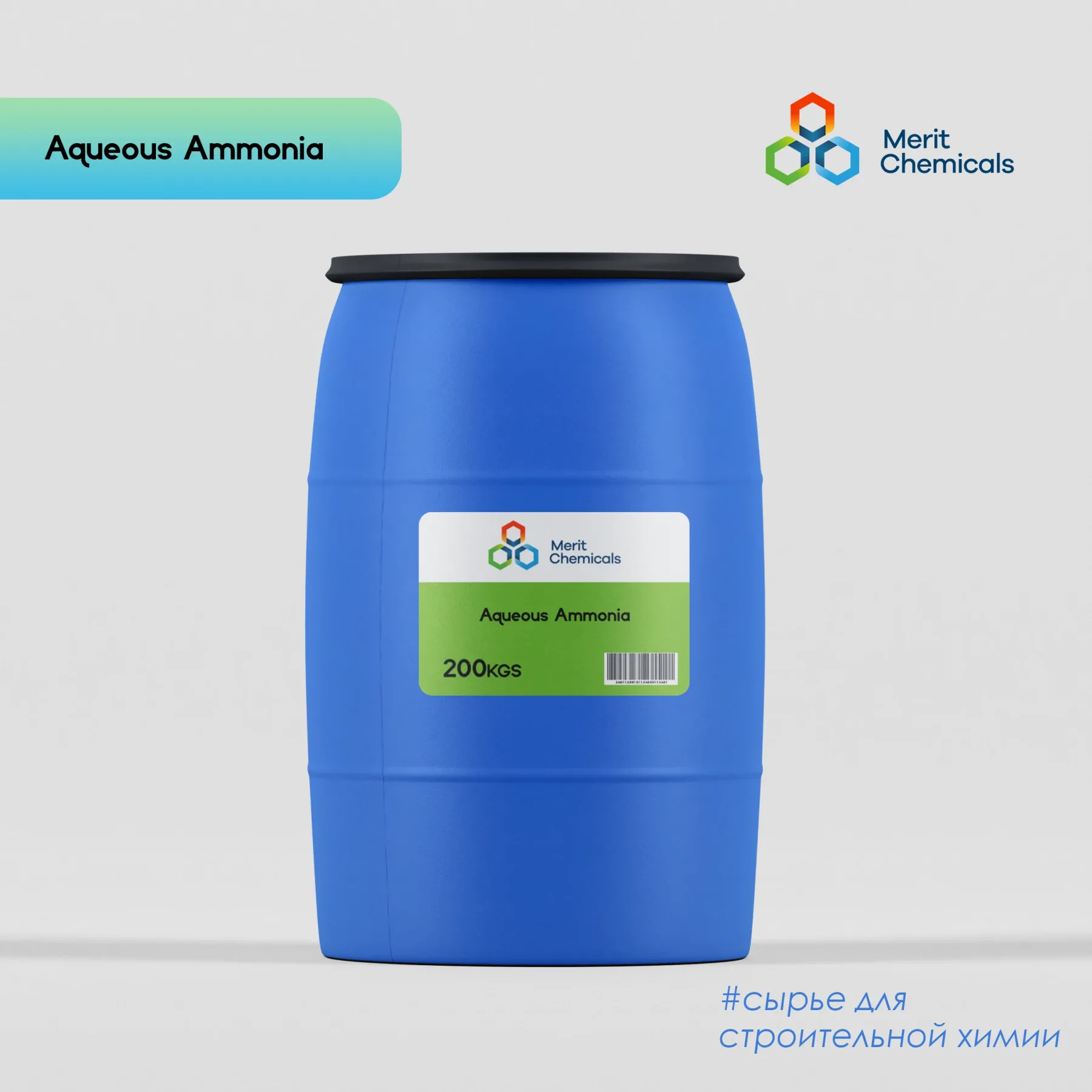
- Plastic chemical drums of 200–227 liters.